For Keats’ Sake
More casualties of the impenetrable truth
“Beauty is truth, truth beauty,-that is all
Ye know on earth and all ye need to know.”
– A hip joint in the metaphysical world of literature and among the most deliciously discussed stanzas in the poetic world, possibly because we aren’t precisely sure what is meant by this outro, though it is generally agreed that the beauty of the art adorning the Grecian urn about which Keats writes, “implicitly affirms the sufficiency of human intellect, and explicitly affirms the equation of beauty and truth….” as Dennis Dean neatly puts it in the Philological Quarterly. So the urn itself serves to adorn the human condition with a comforting sense of adequacy, and no purer form of beauty exists beyond something’s true nature. Got it.
Truth(fulness) is a virtue instilled in most of us from a young age; taught and nourished through almost all religious scriptures; a spiritual cornerstone of the cause-and-effect karma of human conscience. “Thou shalt not bear false witness” Jews and Christians are told (via God’s own hand on a stone tablet no less); the Quran too focuses many of its moral and spiritual lessons around the derision of deception – “he who deceives is not one of us” the Prophet of Allah makes quite clear when addressing a Medina market trader who conceals the dampness of his corn by placing dry corn over the top of it.
So ‘truth’, we are taught, is vital. But the problem is ‘the truth’ is increasingly impenetrable in today’s cocophony and we are dangerously close to abandoning any appetite for honesty and accuracy whatsoever. Yes there is the conceptual value of something being utterly, irrefutably mechanically accurate (Ilyus Khan talks of the beauty of Calculus reducing grown men to tears) but in modern life, a search for the truth is practically unrealistic. Instead we can merely keep sharpening and whittling our wits just enough to hack through the flotsam and jetsam of modern life’s campaigns or wisdom, tabloids and tweets, and try to sieve out something we are vaguely comfortable with.
The truth has become almost entirely elusive where it matters. 2+2=4 is pretty indefatigable, but beyond comprehensible arithmetic the rest is always some form of opinion, with some form of agenda. There are therefore lots of ‘truths’, colours, versions – some identifiably more credible than others; but little today is genuinely cut-glass crystal clear and conclusively beautiful.
The Keats verse is still mulled over some two hundred years later, with the precise meaning ultimately of course impenetrable. This is of course an important principle of the beauty of art. That deliberate ambiguity, unspecification, is where the reader can install their own affinity, interpretation and joy.
So some of the most discussed lines on the beauty of truth are both unspecific and ambiguous. But this is art… That’s part of the wonder, the mystery, the freedom to interpret the abstract painting. In practical matters however, where we need accuracy and specification, despite never having had such an abundance of accessible information, we now remain even more baffled; the true nature of something seems ever more distant; we are left scrabbling around for the truth needles in the information haystacks, helplessly trying to separate the wheat from the chaff, the dry corn from the wet.
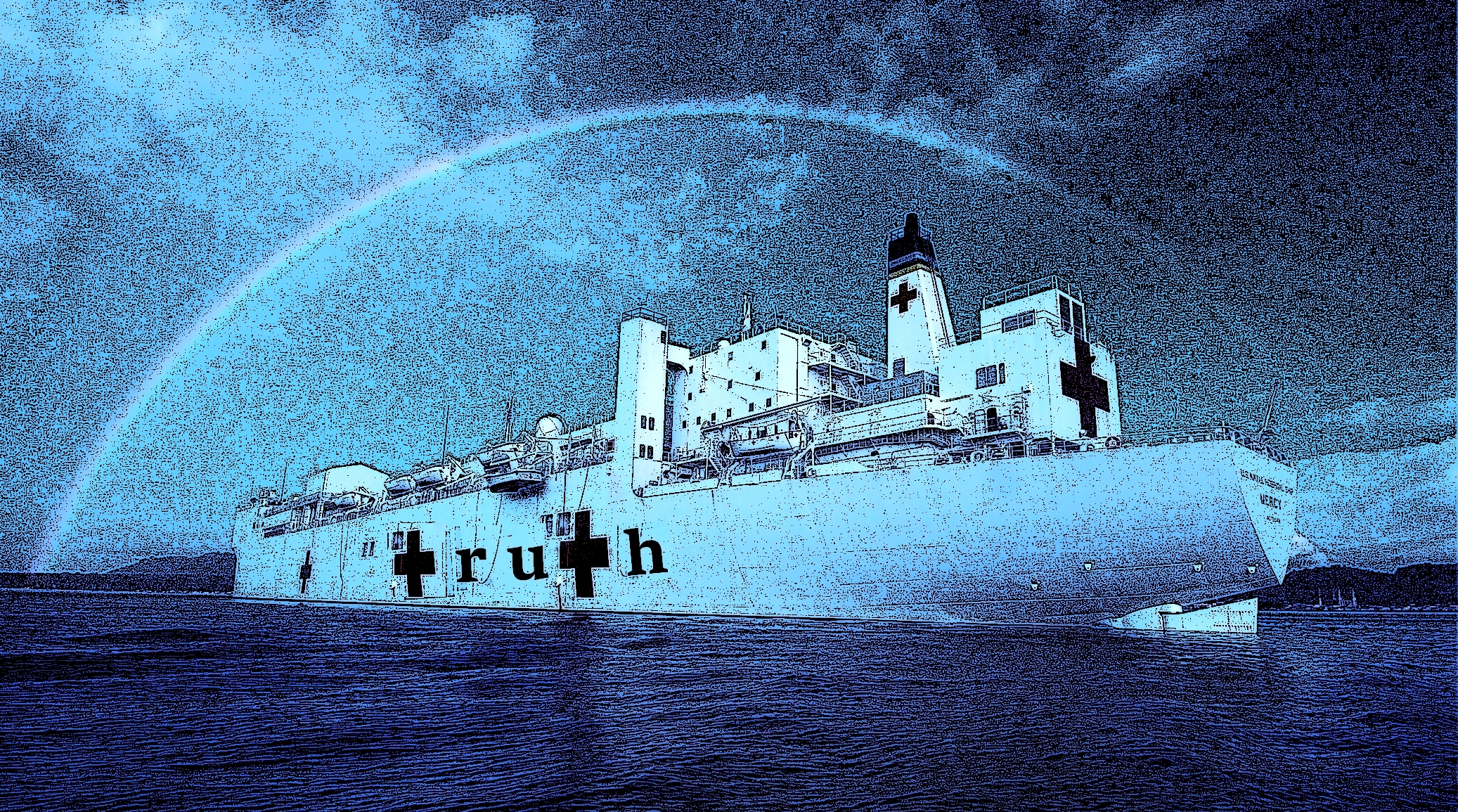
I remember seeing a cartoon – by which the above graphic is inspired – reminding us that “the first casualty of war is truth” – variously attributed but corroboratively recorded over 2500years ago in the Greek writings of Aeschylus – is a well established sound-bite now and one which reminds us there are certain situations where it doesn’t even suit us to have the truth. “The truth” will be planned, designed and fashioned, and we will have to accept it. “I want the truth”, “You can’t handle the truth!” type of affair.
Accepting the fact that we will rarely consume any media which is absolutely without bias, this does not mean that we should all somnambulate into tolerating such ubiquitous misinformation, hyperbole and deceit which seems to populate almost every campaign, advertisement, story or claim. Like a sort of known virus, it has now mutated and grown well above in direct proportion to the amount of media we take in, to the point of pandemic, where even important political decisions are now being made under the influence of the partisan party drug.
Of course we each still want to fulfill our own individual moral imperatives – whatever their shades or styles – with our friends and neighbours. And of course we begin each day with some standard-issue reserves of enthusiasm and patience ready to tackle the tangled webs of spoken and written data. But we are being forced more and more to have to permanently painstakingly decode our own version of an acceptable, balanced stance, like a sort of lifetime mental aptitude test.
In thinking-time-poor modern life, faced with an entire haybarn of haystacks at every turn, we often reach a point of such exasperation that we withdraw into accuracy apathy. We simply do not have the time, energy or enthusiasm to drill down into and cross examine every single exhibit thrown at us in order to assess its integrity or credibility in order to make what we think is ‘the right decision’.
The simple act of buying a new kettle or booking a weekend away has now turned into a complex and painful task like a maze littered with banana skins. More choice, we are told, is good news for the consumer. That might be true to an extent, but having such a breadth of choice with a catalogue of comments and reviews and buying options for every product means instead of nipping to a shop and buying a kettle, we are conducting our own individual research project wading through the foggy landmass of material at our disposal.
The highs and lows of reading user reviews or Trip Advisor comments take us on an emotional rollercoaster. Just when you think you’ve settled on something; Bang; there’s a handful of one star reviews saying it’s shit. And we can’t trust all the good reviews can we? they could be fake, but could some of the bad ones be fake too? what percentage of the overall reviews are bad, more than 10%? How on earth are we supposed to decipher all this….is all this information actually beneficial or not? Enter blissful ignorance for some here.
Transparency and the marketing folk no longer chat at parties. Deciphering supermarket or mobile phone offers nowadays requires a degree in forensic statistics. The marketing and retail men and women seem to give us irritating little equations to do to work out the best value; changing the way weights and measures are quantified; prices altering after a honeymoon term, initial offers, discounts and cashback. If I’d wanted this type of coffee-break-puzzle I’d leaf to the middle pages of a tabloid newspaper, I do not want to be forced to do it at 5.45pm in a packed supermarket after a grim day at work and forty minutes in traffic.
In times of austerity and domestic budget examination, we need some accuracy as consumers – especially on value. Value for money has seldom been more important. Many readers may be comfortable enough not to have to engage in these irritating little calculations, and can just willingly go for the nice branding or the established favourites, but many of us need to make adjustments – changing our regular supermarket, or opting for more own-brand products, or drinking three less bottles of San Miguel every evening. Stores Aldi and Lidl have seen spectacular growth in recent years in the UK, largely as a result of a war on price – head to head binary fist fights of pounds and pence. And the simple notions of their campaigns – similar but cheaper – seem to have worked.
Most retailers are guilty of scattering soil on the shallow grave of truth through a type of deliberate obfuscation: This dijon mustard here in the small print beneath the price, says it’s £1.43 per 100g,… this other one next to it is – oh hang on they’ve calculated this one per kilogram instead of per 100g, that’s helpful, so it’s £15.35 per kg, which is erm, divide it by ten, £1.535 per 100g – thanks for that you irritating bastards, I’m here dividing random numbers by ten to check I’m not being ripped off when I’m trying to get home. Why not put a f***ing sudoku underneath or a codeword puzzle for all the additives. How have we let this happen?
The prospect of changing any form of household utility, or any service which carries an ongoing financial commitment and is contractually exclusive, fills us with a morbid resignation, akin to that of waiting for a surgical procedure. Mobile phones, broadband, gas, electricity, ..please No……! The only people left in the country to have these arranged in the most advantageous fashion is the young lady from Countdown and that Martin Lewis chap who does the money programmes.
Some products are difficult to differentiate when they are invisible or as simply utilitarian as electricity, gas, or communication networks. Is my electricity of the same quality as my neighbours? I’d say so, in fact it will be absolutely identical, so where suppliers sense challenges in depicting physical differences between products, enter the algebraic coffee break puzzle book of the tariffs, standing charges, discounts, offers, add-ons, contract lengths, fixed versus variable jungle of tangled figures for us to start hacking through.
This broadband deal is £12.99 for the first three months, BUT then £24.99 thereafter, and it’s a, erm hang on, 18…, yes 18month contract, and I’ll have to pay line rental of £16.99…so…hmm, …and this other one is £22.00 per month and a 12month contract, and the line rental is £14.99 but it has a limit of 10gb per month, but the other one had free weekend calls..hmm..right so.. how much downloading do I do.., what about Netflix..erm.., and I do skype Aunty Carol quite a lot now she’s in Belize, ah..and I might be downloading more music now I’ve just discovered AOR…………………..hang on I’ll just put aside nine hours of my hectic life, (shut up kids I’m busy), to chart my entire estimated annual data and phone usage, working out how many box sets I might watch over the next 12 or 18months, do a spreadsheet with all the offers on then give Pythagoras a ring to work out the best deal.
And so often we just think, actually, sod it. I haven’t got time for this shit. I have a life to get on with. It gets us riled that we know we’ll never untangle it. So let’s just plump for one and I’ll put up with the feeling of accepting somewhere I’ll get shafted because they’ve out-stared me, I’m weary and fatigued, yes, I’ve blinked first, I concede, get on with it, my trousers are down.
The concept of the headline figure has meant there will be an equation and a stack of Ts&Cs crouched camouflaged behind a tantalising competitive headline price for something, be it broadband or dare I even mention, flights. This figure acts as the front line infantry soldier of the price war, emblazoned on billboards; in flickering online banner ads; in big fonts on shouty TV ads and trodden like muddy footprints through your social media timelines. And they employ a small arsenal of light artillery; specifically the lexical wriggle room of ‘up to’, ‘from’ and with them the ill-boding, ominous asterisk*.
“Up to 50% off!” usually means one or two usually highly undesirable items may have this amount applied to an already quixotic initial asking price, but the bulk of sale items will be offered with more parsimonious price cuts. “Seats from £9.99!” will mean the same severely limited application of such a tariff across airline ticket prices and have us hunting for exclusions, and if coupled with an asterisk, “Nike running shoes from just £15.99!*” would have us checking whether this was just for one shoe. We have to scour the advert for the symbol legend to work out the terms, conditions, limitations and omissions to work out if the offer actually only applied on a rainy Thursday to a mandarin speaking octopus.
This type of deliberate dissonance in marketing and advertising in the form of a psychometric endurance test is not unusual and keeps lots of people in jobs, thinking up new ways to befuddle the consumer to the point of either successful hoodwinking or throwing in the white towel. This is where design and subterfuge does the dirty work of commerce. This is seen as ‘creative’, these people work in the ‘creative marketing industry’, in the same way other people in a room shouting random numbers at you whilst you’re doing mental arithmetic is creative.
My theory about marketing people is similar to that of architects – if this occasionally self congratulating, sometimes borderline supercilious community is truly deserved of their artistic and commercial fusion smugness, then how come most of the buildings in the last 50 years and most adverts on the telly are so shit? Case rested. Let’s hear that laughy confusion of that lady’s voice as she ponders with me how to “go pro” with her toothpaste. Oh do f*** off. At least the Aquafresh family had a sort of nostalgic crap animation to it and a catchy song.
We digress. You can read the full article on the antagonising obfuscation of the marketing folk here.
A search for some form of beautiful truth therefore we have concluded is too big a task, too big an ask, on most issues. We don’t have the time to individually and rapidly credentialise and grade each piece of information we are presented with, in order that we can make the appropriate squeezes and moulds to our hand-held putty version of the truth. So we have become accustomed to settling for the next best thing: our semi-comfortable, post-minimal-analysis, elementary understanding based, personal educated opinion. Let’s try and have an opinion which we are vaguely comfortable with – a sort of partially constructed position with some fairly reliable foundations, although might have some dodgy brickwork and an ugly extension on the back. Enough of an opinion, say, to get us through a dinner party conversation or some in-law-safe-territory chat, or to be able to spend a few quid without buyer’s remorse or bedtime gremlins. This is the house we will have to be comfortable in on a daily basis unless we want to go around muttering like Rain Man. And whilst this won’t make us feel especially erudite, or even well informed, it should prevent us from feeling entirely uncultivated and therefore vulnerable, and that’ll be just enough.
As our energy for assessing factuality in daily life can now fit into an elf’s espadrille, thus our new evolutionary achilles heel develops year on year. We become more and more vulnerable. They know that we know that they know we’re too busy or too mentally exhausted to decipher their hieroglyphic marketing dingbats. So sneak in the bullshit while the guard’s asleep. <Loads of info = less truth> continues, and in many ways doesn’t trouble us as much as perhaps it ought to….
…Until that is we have a say on matters which can significantly affect our lives or the lives of others; an electoral or judicial voice for example. Sharpen your pencils everyone. This is important decision making now, but hang on, we’re way outta shape for this, we’ve all got scrutiny sunstroke and decision making dystrophy…
Most people reading this will be lucky enough to live in a governmental system of democracy. The population will elect their own rulers. Magic. From the Latin and Greek words “demos” or “demokratia” meaning ‘of the people’ or ‘rule by the commoners’ this must be the fairest method of polity and policy making available to modern mankind? This is the system people have died for – the fight for freedom against oppression. The system we bomb our way to superimpose upon outmoded dictatorships or tribal rules. Every citizen has a vote, and the majority vote determines the ruler, so not perfect – no political system is – but as close as we can get. (Okay so 544,00 more people voted for Gore than Bush but let’s not let that confuse things, there were rules…). We are lucky, our forefathers (and foremothers) had that fight and were triumphant, so that we can relax in the political world’s finest resort.
But be careful. Because now the quality of the information and the resistance to apathy becomes critically important. As does the fight against the radar chaff and the mustard sudoku. The problem is that it is so easy to quickly conceive and disseminate utterly convincing but wildly inaccurate information, with the sniper penetration that corporations salivate over, that if this is the only ‘information’ we happen to absorb on an issue, here begins our journey on forming our personal educated opinion.
The citizen who has solely consumed well presented contentions but with a heavily partisan agenda, has little choice other than to give it the pinch of salt treatment and pop it in their opinion quiver. The citizen who has taken greater time and effort to unpack and dismantle a complete spectrum – contemplatively seeking information on both sides and balancing arguments against credibility and suitability – has exactly the same vote. No matter how well informed an elector is, his power is equal, whether he has avoided spurious persuasion or not.
The council elections in the UK in May 2016 were widely depicted on a number of infographic type coloured maps of the country to demonstrate an ‘actual’ volume of votes for a particular party. One of these quickly became viral, popping up and whizzing through everybody’s news feed on their social media. Set out as a ‘the real results’ challenging the mainstream media portrayals, it played upon an already established distrust of the media and drew people in to relish and share it. With a cloak of pseudo insightfulness it masqueraded as a queue jumper straight to the revelatory real truth, the ‘real picture’.
The trouble is, it was false; fake. Moreover as it was tweeted by a (fake) journalist it was given further credence and picked up by large media organisations, accepting the poison apple. Mainstream news then circulated it, wearing it almost as a badge of honour for truth activism, effectively going full circle round the media, (or more a figure of eight when it was soon debunked), in terms of its credibility. It went through the credibility hall of mirrors. And we the laypeople are meant to have the antennae and internal processing capability to sense this double bluff? Read Jim Waterson’s article about it here. It’s frightening.
And dare we mention the UK Referendum on leaving the EU? “We send the EU £350million a week, Let’s fund our NHS instead” was the famous slogan, printed on bus sides and blurted out in wonderfully ‘balanced’ TV and radio debates.This of course resonated beyond those waiting for a new knee. “EU migrants take British jobs and drive down wages” (to paraphrase another popular contention of the campaign) These campaigns stirred, seasoned and spiked a cocktail we all swigged down like the opium of the people via tabloid and other media platoons.
Gosh what to think? We mused. That sounds like a pretty robust reason to vote out doesn’t it? getting all our money back, and taps into the good old patriotism, the sort of silver bullet solution our precarious economy could do with yeah…but can this be trusted? how do we know? The truth police tried to shine a light on it close to the vote: The Guardian 10th June: “the UK Statistics Authority no longer says it is potentially misleading, but misleading plain and simple; and for the respected Institute for Fiscal Studies, it is “absurd”. Ah okay so we’ve done some detective work and found out this is to be categorised as highly questionable. But by a newspaper with a slight socialist lean but one which sides to remain in the EU. OK, checks and balances applied. Noted. But has everyone exercised this scrutiny. Do they even want to?
The counter argument for Remain was almost exclusively economically centered, and seemed credible if immeasurable, but could too be easily undone by the indisputable contention that nobody could accurately predict what trading conditions would ultimately transpire if we left. So we are completely in the hands of the campaigners and commentators on this one, because nobody even knows what the truth is, it’s all down to our own assessment and analysis. Faced with two the choice of two scenarios, neither of which could be adequately explained to us, off we went.
But it doesn’t matter, it’s too late. The resonance had invigorated those most mobilised in these situations – the masses with a gripe who still work on face value and don’t want to look behind the headlines. It would be unfair to argue that an easily-led, less educated body of the electorate, born out of patriotism, disgruntlement, and their own internal conviction, could be roused and so viscerally enagaged to a viewpoint which would actually withstand little intellectual scrutiny. After all their vote is as good as yours, don’t be so patronising. Yet even some ‘Brexiteers’ conceded they had been duped and served parsimonious dishes of accuracy with lots of salt. They took the promises at face value only to be told the following morning that some of it wasn’t strictly as it was set out. But it was too late. The horse had bolted. Whatever promises or warnings were given about opening the stable door are irrelevant now, the door has been opened.
What then becomes of the value of this precious vote if we do not have the skill or inclination to look beneath the dry corn? Are we really free from a conceptual form of oppression which characterises dictatorships? Is the fight for democracy really over, or did it only start once we achieved it? Social media does not discriminate between mathematical maxims and deliberate false testimonies – facts or fibs – in its universal oxygenation of forest fires of information spreading through our camp.
Such is the opacity of modern political campaigning data, what should be a clear and detailed assessment of who best rules us, has boiled down to a simple stick-or-twist gamble. Stay the same or risk letting someone else have a go?
The problem with such volumes of information, at such velocity, and the inability to readily authenticate any of it is that it causes a dystrophic degeneration of the very tissue of democracy; that it is only as fair as the quality of the information provided upon which to make a judgment, is accurate.
The UK Brexit Referendum should frighten some of us into getting a form of Norton antivirus for all the data we are having missiled at us or slipped in our tea. Trump v Clinton has the same hospital-bedside-head-holding sort of worry, where even the medics can’t tell us if the drugs will work. The apparent absurdity of a campaign or candidate with extreme ideas and combustible binary solutions to complicated problems might seem outrageous to some, but to others it is refreshing, positive, and progressive. Thinking that surely something could never happen is a dangerous type of incredulity. These things might be contested like a reality TV show but don’t lose sight of the reality here.
Thus we find ourselves in a new chapter in our fight for democracy – one of unflinching scrutiny – we must all commit to empower the younger generations to take arms against the dictatorship of misinformation; to ridicule the spurious maps and pathetic claims, and instead to champion an inquisitiveness and analytical curiousness to curse through the sludge of modern crap.
Never before has so much persuasion been actuated upon so many people, by so few. We must fight them in the supermarkets, we must fight them in the streets, we must fight them in all the far reaches of today’s modern media, in this desperate war against the over-promising, sugary, Lorely eyes of what seems a convincing solution, or is convenient, or feels like it could be right. Face value is in recession, we must stay strong and all fight to seek the real beauty of exactitude, accuracy, honesty: “truth”
For Keats’ sake.
 thebleat.co.uk
Leave a comment